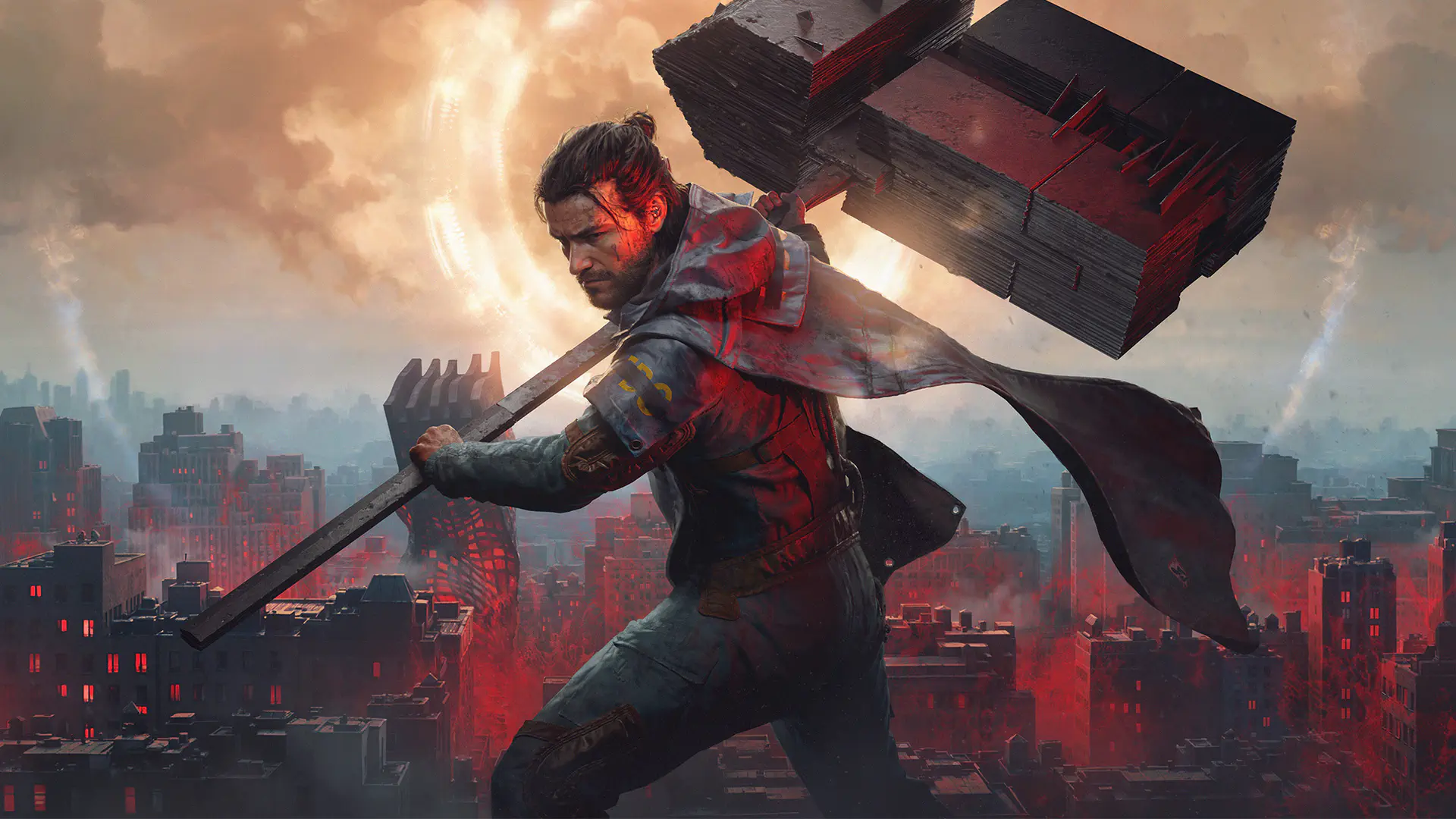
Seven years ago, Control locked us inside the Oldest House, a massive concrete maze where you never knew what was waiting behind the next door or why FBC employees kept discussing office problems while reality itself collapsed around them. It was a bizarre mix of bureaucracy, SCP, mysticism, and classic Remedy weirdness that somehow worked almost perfectly.Control Resonant does the exact opposite. Dylan Faden finally gets outside, the Hiss spills into Manhattan, and the compact maze of the Oldest House gives way to huge city districts, RPG progression, side activities, and a much more elaborate build system.On paper, it sounds like the natural evolution of the first game: a bigger world, more freedom, more content, deeper combat. In practice, Resonant too often feels like a game that stretched a familiar formula without figuring out what to fill all that extra space with.
This Is a Very Different Control
Dylan Faden is the protagonist this time around. After the events of the first game, he spent years in a coma and wakes up just as the Oldest House's long isolation finally begins to crack. The Hiss escapes into the outside world, Manhattan is cut off from everything beyond it, Jesse disappears, and the FBC is forced to rely on the same man the Bureau spent decades treating like a test subject.Control ResonantControl ResonantThe basic idea is genuinely good. Dylan knows almost nothing about the outside world and struggles with ordinary social situations, while also understanding perfectly well just how awful the Federal Bureau of Control can be.The problem is that for a long time, he feels more like a collection of obvious character traits than a genuinely compelling protagonist. His social awkwardness is constantly emphasized, his past trauma is regularly spelled out, and his relationships with other characters develop in fairly predictable ways.His dynamic with Agent Zoe works best. She spends most of the game as a voice in his ear and gradually stops treating Dylan like yet another troublesome FBC asset. The two develop some believable chemistry, although a few conversations still sound like they could have used one more editing pass.Still, Dylan is not the real problem. Control Resonant simply tries to tell too many stories at once. There is the relationship between brother and sister, the FBC experiments, Dylan's guilt, Jesse's fate, new paranatural entities called Resonants, another global catastrophe, and a whole pile of smaller local storylines. As a result, the narrative keeps spreading itself too thin.Control ResonantControl ResonantIndividual scenes and twists can work, but they never come together into something as tight and cohesive as the first Control. At times, Resonant feels like a game that desperately wants to be more emotional than its predecessor but explains those emotions far too directly.
Manhattan Is Impressive for the First Few Hours
The most obvious change is the structure of the world. Remedy carefully avoids calling it an open world, and technically the developers are right. Manhattan is divided into large districts, with travel between them gradually opening up. Still, it feels very much like a modern, large-scale action RPG.Events, activities, merchants, points of interest, and FBC assignments appear on the map. You help Rangers, protect personnel, eliminate particularly dangerous enemies, and complete other familiar objectives.Control ResonantControl ResonantFor the first few hours, the city really is impressive. New York streets literally fold over one another, buildings hang at impossible angles, entire blocks flip upside down, and familiar geometry constantly breaks apart.The problem is that the visual impact wears off surprisingly quickly.The Oldest House was interesting for more than its striking scenery. It constantly made you question the space around you. An ordinary office could suddenly become the entrance to somewhere completely impossible. Manhattan is much more predictable.A street turned vertical is still a street. A district overrun by Mold is still the same district. After a while, you start noticing the same checkpoints, stores, alleys, rooftops, and military fortifications. Yes, the world is bigger, but it is not more interesting. And that is arguably one of Control Resonant's biggest problems: scale too often replaces substance.
Traversal Is Better, Exploration Is Not Always
Traversal is much more interesting. Dylan gradually gains new abilities tied to the Faults and his search for Jesse. Elevate, Double-Jump, and Rush quickly make moving through the districts far more flexible.Shift is especially good. In certain areas, Dylan can change his orientation relative to a surface. A wall becomes the floor, a ceiling turns into a road, and the entire space starts literally rotating around him. These are the moments when Resonant most feels like a game only Remedy could have made.Control ResonantControl ResonantThe best sequences have you running along vertical streets, jumping between warped buildings, and constantly changing the plane you are moving across. Exploration genuinely works in moments like these.But it is not always smooth. Some of the spatial sections try a little too hard to disorient the player. It can be difficult to tell which surface the game actually expects you to use, and certain jumps are less about understanding the puzzle than finding the exact angle the game wants.As a result, an impressive mechanic sometimes turns into wrestling with the camera and wondering why Dylan has once again launched himself in completely the wrong direction.
The Combat Is Deeper, but Not Better
Combat sees the biggest overhaul. Dylan's main weapon is the Aberrant, a paranatural metal weapon capable of changing form. Instead of relying on the Service Weapon, Resonant focuses primarily on melee combat.The Aberrant has multiple forms, damage types, combos, and Combo Enders. Over time, you unlock abilities, elemental effects, and talents that allow you to put together full-fledged builds.Control ResonantControl ResonantThere is plenty of potential here, but the system takes far too long to open up. For the first few hours, you are stuck with a fairly limited moveset and some dull early upgrades. Most fights boil down to dodging attacks, filling the enemy's Falter meter, and then performing an execution.Later, flying enemies, heavy units, Mold creatures, and more interesting enemy combinations start appearing. You can build around critical hits, fire, crowd control, or rapidly applying Falter.The Resonants also add some welcome variety. The Dancer tests your dodging, the Deserter turns its arena into a fiery obstacle course, and other bosses bring their own mechanics. Even so, the foundation of the combat remains debatable.Hits do not always have enough weight behind them, soft lock-on sometimes grabs the wrong target, and large groups can turn into visual chaos once the camera and effects start fighting for your attention.Control ResonantControl ResonantMore importantly, the original Control simply felt better at the most basic level. Hurling a chunk of wall at one enemy, grabbing another with telekinesis, and immediately going back to shooting was simply more fun.Resonant needs much more time before its combat starts to click. Yes, the system is deeper and more elaborate, but it no longer feels quite as natural.
A Bigger Game Means More Busywork
This is where Control Resonant starts losing its identity most noticeably. Manhattan is packed with events, FBC assignments, and smaller activities. You can escort Rangers, clear out enemies, protect personnel, and complete all sorts of familiar objectives.To be fair, this is hardly the worst open world ever made. These tasks are usually short and fit reasonably well into exploration. The problem is that they are in Control at all.Control ResonantControl ResonantThe original trained you to expect that any optional corridor could lead to a bizarre paranatural object, an absurd memo, or a self-contained little story. In Resonant, another icon on the map too often means another fight.It also hurts the pacing of the main story. The game can drop a major revelation, only for Zoe to suggest some routine side job almost immediately afterward. It is the equivalent of: Run after him, he's getting away! followed seconds later by: Wait, there's a dragon nearby, let's find it and bring it to a dog!Moments like these constantly remind you that this is no longer a compact adventure. It is a big game full of interconnected systems, and unfortunately, not all of them feel like they needed to be here.
The Best Quests Are the Ones Where Remedy Forgets About Scale
The funny thing is that Control Resonant is almost always at its best when it stops trying to be huge.You can encounter a camera that cannot be approached from the front. You can chase a strange baby carriage. You can enter a Threshold filled with anomalous taxis and work out the correct cab by watching their flashing lights. There are standalone puzzles, arcade challenges, hidden caches, and small scenes Dylan assembles from objects around him for his drawings.Control ResonantControl ResonantThis is where that familiar Remedy magic returns. It is especially noticeable in the Underpass. When Manhattan's streets give way to enormous office structures, strange reports, audio recordings, and stories about FBC employees, the game finally starts feeling like the first Control again.That is both exciting and a little frustrating. Resonant's best hours constantly remind you just how much better this series works inside smaller, denser, carefully constructed spaces.
The Visuals Are Hard to Fault
Artistically, Remedy remains one of the most recognizable studios in the industry. A ruined Manhattan gives the developers enormous freedom to experiment with perspective, architecture, and scale. Entire streets can hang in midair, buildings reflect back into themselves, and Mold-infested districts gradually transform into almost alien spaces. The game is at its best visually when it abandons realism altogether and dives into pure abstraction.Control ResonantControl ResonantRemedy's signature mix of in-engine scenes, live-action footage, and stylized sequences is still here. Casper Darling also returns and immediately reminds you why characters like him matter so much to Control's atmosphere.But even excellent art direction cannot completely hide how repetitive Manhattan itself becomes.In the first game, nearly every major room had an identity of its own. Here, you spend too much time walking through streets that are merely good while waiting for the next truly memorable location.
Control Resonant Is a Decent Game That Should Have Been More
It is difficult to call Control Resonant a failure. It is a competent action RPG with a beautiful world, interesting ideas, good side quests, and a handful of genuinely excellent sequences. But that is not enough for a sequel to Control.Remedy expanded almost everything: the map, progression, number of activities, combat options, and traversal mechanics.Control ResonantControl ResonantAt the same time, the game itself has become less cohesive. The story sprawls. Manhattan quickly loses its novelty. Combat takes too long to come into its own. Standard activities feel out of place, while Remedy's signature madness has to be actively hunted down between the more conventional pieces of a big RPG.Sometimes Resonant becomes exactly the game you wanted it to be. Usually, that happens when it locks Dylan inside some strange room, switches off the normal rules of reality, and starts telling another story about a person who was simply trying to do their job inside a completely abnormal organization.But those moments are constantly sitting alongside something far more ordinary.In the end, Control Resonant does not feel like a bad game. It feels like an uneven, middle-of-the-road one with several excellent stretches. It is bigger in almost every way, but increasing the scale did not automatically make it better.The first Control was smaller and simpler, but it understood exactly what it wanted to be.
7/10
NOWGAME SCOREVerdict
A quick look at the game’s strengths and weaknesses.
Pros
Beautiful and occasionally spectacular visual design
Impressive spatial anomalies and the Shift mechanic
Strong side quests with Remedy's signature weirdness
Interesting ideas for exploration and traversal
Deeper buildcrafting and character progression
Memorable Resonants and standout story sequences
Good chemistry between Dylan and Zoe
Excellent moments in the Underpass that recapture the atmosphere of the first Control
Cons
The story is noticeably less focused and cohesive than the original