In the first hours of Permafrost, staying warm and learning the basic tools matters more than filling your backpack with random loot. This guide explains what to craft first, how to hunt and cook food, how to get the dog companion, and how to establish your first base. We also cover the early recipes, quests, and dangerous cold states so your first expedition ends with a trip home instead of a frozen monument to greed.This guide is based on pre-release build 0.44.2, the final playtest, and developer information available before Early Access. Permafrost enters Early Access on October 9, 2026, so recipes, quest order, and balance values may still change. If the live game differs, follow the current Journal, Blueprints screen, and crafting menus. For the release date, price, PC requirements, and Early Access details, see our Permafrost before-you-buy guide.
For a first playthrough, we recommend Survivor or Hunter. Survivor starts with clothing, Improvised Tea, and a Muesli Bar, while Hunter starts with Coffee and Instant Oatmeal. Improvised Tea and Improvised Coffee are useful because warm drinks help restore body heat while you are still learning where the nearest safe shelters are. Save them for moments when the warmth actually matters instead of consuming everything immediately.PermafrostPermafrostSmuggler starts with an Energy Drink and Chocolate, which solve a different set of problems. Your Origin determines starting equipment, while skill bonuses are tied to specialization, so do not treat those as the same choice. You also do not need to spend an hour searching for the mathematically perfect Origin. Even a strong starting kit will not save a character who immediately walks toward every snowy horizon with no plan to get warm again.
What to do first: tools and fire
Check your equipment and read the objectives for A New Beginning. The opening quest introduces resource gathering, the Campfire, and basic crafting. Do not wander far before you understand how heating works. Start by collecting Wood and Stone. You need them for the first three useful tools and structures:
Stone Axe - 2 Stone and 4 Wood. Crafted by hand without a Workbench and used for gathering Wood.
Stone Pickaxe - 2 Stone and 4 Wood. Also hand-crafted and used for mining Stone and Flint.
Campfire - 2 Stone. Placed with the Building Tool and then supplied with fuel and lit.
Crafting all three costs 6 Stone and 8 Wood. That is the recipe total, not the amount you should leave home with. Wood is also needed as fuel and for the next round of crafting. If your body heat is already running low, light an available fire and recover first, then finish gathering the rest. Survival matters more than completing the checklist in a pretty order.PermafrostPermafrostDuring the tutorial near the abandoned shack, use the existing brazier rather than immediately trying to build a full house. Gather nearby Wood, turn the heat source on, rest in the tent, and check the food containers. Existing shelters are valuable because they let you learn the systems without spending resources that are more useful elsewhere.
How to avoid freezing on your first expedition
Body Heat and clothing insulation are different things. Better clothing slows the rate at which heat is lost, while fire and appropriate consumables help restore it. A good coat makes a trip last longer, but it does not replace a heat source. Warm up before leaving and remember the nearest place you can safely return to.Cold warnings escalate as conditions become more dangerous. A low-temperature warning means you are losing warmth. When you enter Bone-Chilling Cold or a Cold Zone, treat that as a reason to shorten the trip unless you are properly equipped. Hypothermia starts damaging your health and makes movement more difficult. Once that happens, reaching warmth matters more than finishing the next container.PermafrostPermafrostStart with short trips for one clear resource. Get Wood, return, craft what you need, then go farther. There is no universal safe number of minutes outside because survival time depends on clothing, character condition, weather, and the area itself. Always turn back with enough warmth left for the return journey.Leave the harshest Cold Zones until you have better clothing, portable heat options, and warming consumables. The developers describe these zones as places where surviving for long is impossible without serious preparation. "I will only take a quick look" is exactly the kind of decision that turns a resource run into a rescue mission.
What should you keep in your backpack?
After crafting the first tools, open the Blueprints screen. Having the materials is not enough if the recipe itself is still locked. Early progression makes Rope important. It is crafted from 2 Cloth and is needed for the Crude Bow.Do not convert every piece of Cloth into Rope. Cloth is also used by Bandages and later base recipes. Current early-game data makes Rope one of the first Blueprint unlocks worth taking because it gates the bow, while Cloth becomes important again almost immediately for the dog rescue and shelter construction.Look for Cloth in containers, cabinets, luggage, and similar loot spots. A New Beginning can provide early Cloth, but that is not a reason to spend every piece as soon as you get it. Keep some available before Dog Days because you will need a Bandage.A practical early kit looks like this:
Axe and Pickaxe for gathering nearby resources.
Wood and enough fuel or materials to create heat along your route.
Prepared food and at least one warming drink if available.
Makeshift Bandage in case you start Bleeding.
Crude Bow and Wooden Arrows once you unlock and craft them.
Adjust the loadout to the objective and the space you have. A five-minute Stone run does not require your entire pantry. Exploring an unfamiliar area does justify more food, treatment, and heat options. Leave some inventory space for the resource you actually went out to collect.
How to hunt and cook your first food
The Crude Bow is crafted from 2 Wood and 1 Rope. It uses Wooden Arrows, so make ammunition before leaving to hunt. Start with prey you can kill and process without chasing it deep into unknown terrain. The bow gives you range, but it does not immediately make a new survivor the apex predator of the frozen world.PermafrostPermafrostEarly hunting objectives teach the basic loop: prepare a weapon, kill a deer, skin the carcass, collect Meat, light a Campfire, and cook the food. Keep an eye on the active Journal objective so you do not skip the specific action the quest is checking. After a successful hunt, returning to warmth and cooking what you brought back is usually smarter than immediately chasing the next marker with raw Meat filling the backpack.You also need a suitable blade equipped to skin an animal. Early game examples include the Stone Shiv, while later versions of the tool can do the same job. If the game tells you that the wrong tool is equipped, swap before assuming the carcass is bugged.Cook Meat before eating it yourself. Raw food can expose the character to Parasites. Food, healing, and warmth also solve different problems. A Bandage does not remove hunger, and a full stomach does not stop Hypothermia. Before a long trip, check each survival need separately rather than treating one green bar as proof that everything is fine.
Which early quests should you complete, and how do you get the dog?
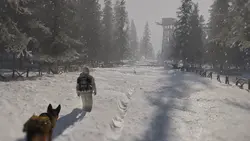
Follow the opening story through A New Beginning and Feel the Heat until you reach the Horizon settlement and meet Robyn. The next short quest is Horizon's Kitchen, which introduces the settlement's cooking setup. Completing it leads directly into Dog Days.Dog Days marks Bone Cave on the map. Before leaving Horizon, bring a Bandage and one piece of raw Meat. Inside the cave, follow the objective deeper until you find the injured and hungry dog. Use the Bandage to treat it, then feed it the raw Meat. The quest completes and the dog becomes your permanent companion.Do not substitute a cooked dish simply because you already have one in the backpack. The quest specifically asks for raw Meat. Your own food should still be cooked. Current walkthrough data also confirms that any suitable Bandage works rather than requiring one unique rare medical item.After the rescue, the dog follows you and opens the companion tutorial. The developers describe it as a scouting partner that warns of danger and carries supplies. It is useful, but it does not replace weapons, route planning, or your own attention. Walking back through the snow feels better with company, especially when the trip brought back food instead of another story about almost freezing to death.
How to build your first base
After Dog Days, New Home begins and introduces your first permanent shelter. The live quest is broader than simply putting down four walls. It teaches you how to build a small wooden structure, claim a Bed, create storage, place a Workbench, upgrade to Flint tools, build a Stone Furnace, and eventually assemble a Radio Station Bench.PermafrostPermafrostStart with the quest objectives rather than designing a huge dream base. A small working shelter with heat, storage, a Bed, and crafting stations is much more valuable than a large unfinished building. New Home eventually asks you to build and claim a Bed, which becomes your respawn point, so do not treat it as decoration.Add storage and leave spare construction materials at home. Before sleeping, make sure the shelter is actually warm. Rest and Sleep help with fatigue and time, but they do not replace heating. Before leaving again, check the character's condition, tools, food, Bandages, and whatever the next quest requires.If a recipe refuses to craft, check three things before gathering more Wood: whether the Blueprint is unlocked, whether the materials are actually in your inventory, and whether the recipe needs a specific station. New Home later introduces the Workbench, Stone Furnace, and Radio Station Bench, so not every item remains hand-crafted forever.At this point, the basic opening loop is established: you have a warm place to return to, basic tools, cooked food, storage, a dog companion, and the next objective in your Journal. In four-player co-op, it helps to divide gathering, cooking, and construction jobs and to agree before spending shared Cloth or other scarce materials. Increase the range of your expeditions gradually. First learn how to come home consistently with useful loot. The cold is not in a hurry, and neither are you.