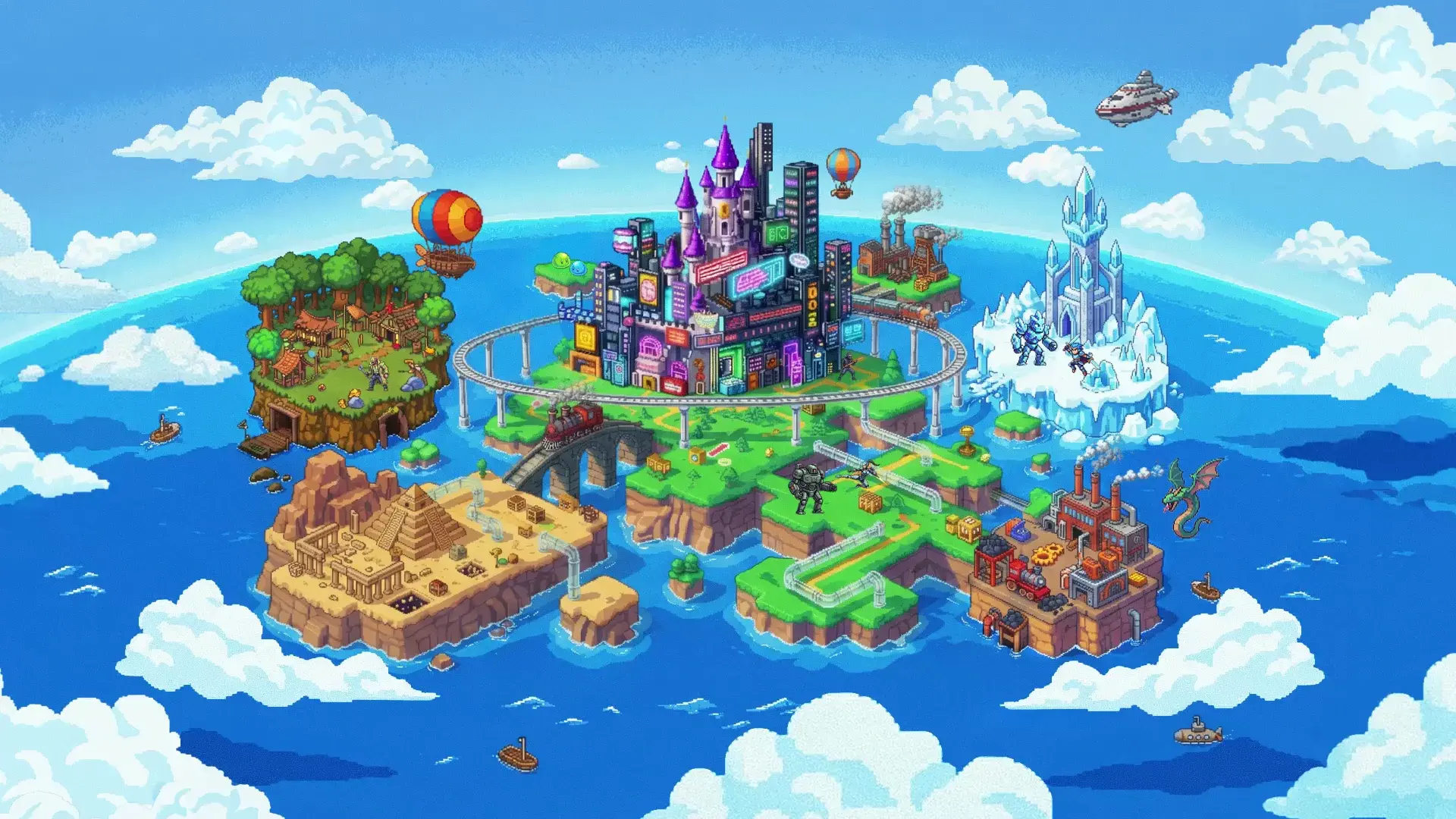
Google now has two ways to turn a game idea into something you can actually play, and they look suspiciously similar at first. Type a prompt, wait for the AI to build something, then tell it what to change. The difference appears when you want to take that first prototype further. Google Playground is built around making, playing, and sharing games in one place, while Google AI Studio gives you more control over the application behind your game. Here's where each one wins, what it can realistically make, and which you should open first.
Google Playground vs Google AI Studio: the short answer
Choose Google Playground if you want to make a playable game quickly, without worrying about code, hosting, or building an audience from scratch. It's a dedicated game-creation platform with prompt-based editing, game pages, community discovery, and built-in ways to compete with friends. You describe a concept, play the result, tweak it, and share it. That's a pretty appealing loop when all you want is to see whether your idea is fun.Choose Google AI Studio if you want to build a game you can keep developing outside Google's creation interface. Its Build mode generates a functioning application, shows you the source code, and supports GitHub, external development, and deployment. That makes it a better starting point for a custom browser game, a more involved prototype, or a project where you expect to add systems the AI doesn't get right on the first attempt.Neither tool automatically produces a polished commercial game. Playground is still experimental, and AI Studio can generate code that needs debugging, testing, and cleanup. The better choice depends less on how impressive the first prompt sounds and more on what you plan to do after the game starts working.
What's the difference between Google Playground and Google AI Studio?
Google PlaygroundGoogle PlaygroundThe two tools share the idea of conversational creation, but their workflows are different. Here is the comparison that actually matters when you're making a game.
Main purpose: Playground is designed specifically for creating and playing games. AI Studio is a general app-building tool that can also generate games.
Coding required: Neither requires you to write code to get started. AI Studio makes direct code editing a more central part of the workflow.
Testing: Playground lets you play the generated game inside its platform. AI Studio provides a live application preview.
Sharing: Playground offers private, unlisted, and discoverable game pages. AI Studio supports app sharing and deployment through services such as Cloud Run.
Community features: Playground has an integrated game gallery, player activity, and leaderboards for eligible games. AI Studio does not provide an equivalent built-in gaming community.
Multiplayer: Both support it, but differently. Playground has an early-preview multiplayer option during game generation; AI Studio offers server-side tools for building networked experiences.
Source code: Both let creators download project files. Playground exports HTML, JavaScript, CSS, and assets, while AI Studio can export its application and sync with GitHub.
Availability: Playground launched in the US for adults aged 18 or older, and free game creation is being rolled out in batches. AI Studio has its own regional and account restrictions, but is not part of the Playground creator waitlist.
What can you make with Google Playground?
Google Playground launched on October 7, 2026, as an experimental place to create and share games through natural-language prompts. You can start with your own idea, use a starter prompt, or follow the guided creation flow. After generation, you can ask the system to change the rules, characters, physics, or environment without opening a code editor.Imagine a tiny dungeon crawler where a skeleton guards each room and the final boss steals your weapons. You could start by describing the rooms and combat, then ask Playground to shorten the boss fight or make enemies move more slowly. You still have to play the result to find out whether those changes work. A convincing screenshot is not the same as a good combat system.Playground's biggest advantage appears after creation. Games can remain private, be shared through an unlisted link, or be submitted to the public gallery. The platform also supports leaderboards for eligible single-player games, along with multiplayer in supported experiences. You are not just building a file and wondering where to put it; the platform already has a place for people to discover and play it.There's a useful feature for creators who want a particular look, too. Playground accepts JPG and PNG reference images and can turn them into stylized game assets. It does not simply insert the uploaded image unchanged, and video uploads are not supported. That means a mood board can help with the aesthetic, but it isn't a substitute for a complete asset pipeline.
Can you download a Google Playground game?
Yes, and this is worth emphasizing. Playground is not a closed box that only lets you share links. Google's official help center explains that creators can open a game in the Creation Studio and select Export (Download Zip). The archive contains its HTML, JavaScript, CSS, and generated assets.
What can you make with Google AI Studio?
Google AI Studio is not exclusively a game generator. Its Build mode can produce web applications from prompts, including browser games. For a web project, the default environment uses a React frontend and can include a Node.js backend, npm packages, database integration, authentication, and server-side logic. You can keep asking for changes, inspect generated files, or edit the code yourself.That makes a difference if your idea goes beyond one screen. Take a turn-based dungeon game with an inventory, several enemy types, a save system, and a leaderboard. AI Studio gives you a route toward building those features as parts of an application instead of treating everything as an isolated mini-game. It still won't magically design balanced encounters or reliable save handling for you, but you have more tools for finding out what's wrong.Google has even published an official Snake & Beats tutorial using AI Studio. The example builds a Snake game with a music player, previews it, saves the project to GitHub, and deploys it. So this isn't merely a theoretical use for Build mode: Google explicitly demonstrates game creation as part of the product's workflow.AI Studio also supports native Android application projects built with Kotlin and Jetpack Compose. That is not the same as generating a Unity project or instantly turning your browser prototype into a finished mobile game. Think of it as a separate development path for people willing to test and maintain a native app.
Which is easier for beginners?
Playground has the simpler route from idea to player. You don't have to decide where to host the game or what framework to use. Start with a straightforward prompt, test the game, and make small changes until it behaves the way you want. Publishing into the same ecosystem is part of the process. If you've never touched a game engine, that's probably the least intimidating entry point.AI Studio is surprisingly approachable, too, because it also accepts plain English. The difference is what happens when something breaks. You may need to understand whether the problem lives in the UI, game logic, database, or deployment setup. Gemini can help troubleshoot, but you remain responsible for checking that its fix didn't break something else.
Which gives you more control over gameplay and code?
In Playground, the default editing experience is conversational. The official workflow encourages focused requests rather than one enormous prompt that rewrites everything. That's sensible advice for any AI-built game: change one mechanic, test it, and only then move on. You can export the files if you eventually want to leave that workflow.AI Studio lets you switch to the Code tab, modify files, connect a GitHub repository, and move development into your own editor. It can also use npm packages and server-side functionality. For a creator who wants custom enemy behavior, persistent progression, or a more involved online game, these are meaningful advantages. They aren't proof that the AI will implement those systems correctly, just that you have more ways to work on them.Our pick for long-term control: Google AI Studio. Playground can export source code, so it isn't a dead end. AI Studio simply makes the transition from prompting to actual software development more natural.
Multiplayer, leaderboards, and playing with friends
This is where Playground feels more like a gaming platform than a creation tool. During initial game generation, eligible creators can select a multiplayer option. Google says it supports both turn-based and real-time games, though the feature is still in early preview. You should expect limitations, and you shouldn't assume every game concept will work perfectly online.For scores, Playground has a ready-made leaderboard system. Publicly listed single-player games can use global rankings, while group leaderboards let friends compete through private invitations. Importantly, the platform's global leaderboards do not apply to multiplayer games. They also aren't available for drafts, private games, or unlisted titles.AI Studio can build multiplayer applications with a backend that handles shared state and connections. That could be useful for a custom co-op prototype or an online game with its own accounts. But you need to design, test, host, and maintain the systems your players rely on. There is no automatic Playground-style audience waiting inside AI Studio.
Which is better for publishing and sharing a game?
Google PlaygroundGoogle PlaygroundPlayground gives you three sensible choices. Keep the game to yourself, share an unlisted link with specific people, or publish it to the gallery where other users can find it. Public games undergo a safety review, and you can continue editing a private draft while an older published version remains playable. It's a comfortable setup for experimentation without breaking the version your friends already have.With AI Studio, sharing an app is possible, but public distribution follows a different route. You can deploy to Google Cloud Run, connect a GitHub repository, or export a ZIP and host the project elsewhere. Google also documents that people you share an AI Studio app with can inspect and fork its code. That's useful for collaboration, but worth knowing if you expected a completely hidden implementation.
Is Google Playground or Google AI Studio free?
Both have free ways to start, but neither offers unlimited creation or hosting. More importantly, their free access works differently.Google Playground is free to play in its supported launch region. For game creation, Google offers a free tier with a limited number of tokens that refresh weekly. However, free creator access is rolling out in batches, so some users must join a waitlist. Google One AI subscribers can receive immediate creation access and higher weekly limits. Google has not committed to one universal creation allowance that every user can rely on.Google AI Studio provides free-tier access to supported models, subject to their usage limits. Building and previewing a simple game may fit within those limits, but paid model usage, Gemini API calls, and hosting can introduce costs. Google's documentation also describes an eligible starter deployment tier for a limited number of apps, so don't assume every published project requires an expensive Cloud Run setup on day one.For both tools, check your account's current quota before planning a large project. Prompt-heavy iteration can consume allowances faster than you expect. If your AI Studio game calls Gemini while players are using it, remember that usage can continue after development is finished. That's a different cost question from generating a game once and sharing the result.
How to make your first game in Google Playground
If you have access to creation, start with something small enough to test in a minute. A platformer, a single-screen survival game, or a short puzzle is easier to evaluate than a huge open-world RPG with fifty systems the AI hasn't implemented yet.
Open Playground, sign in, and make sure game creation is available to your account.
Go to the creation screen, enter a clear prompt, and select the available options for your game. If you want multiplayer, choose that option before generation.
Generate the game and play it. Check the controls, fail state, scoring, and whether the central mechanic is actually fun.
Open the game editor and request one focused improvement at a time. Test after each change.
Keep it private, share an unlisted link, or publish it publicly when you're happy with the result.
Example prompt: Make a top-down survival game set in a haunted supermarket. The player has to collect six batteries while avoiding a ghost that becomes faster every minute. Include a visible timer, clear keyboard controls, a restart button, and a win screen after all batteries are collected.
How to make your first game in Google AI Studio
AI Studio works best when you describe the project as a playable application rather than a cinematic dream. Specify the core loop, controls, states, and what should happen when the player wins or loses. It helps Gemini know which behavior matters most.
Select a web application and describe the game you want to create.
Wait for the generated project, then use the live preview to test movement, scoring, and game-over behavior.
Ask Gemini to fix individual bugs or edit the generated code directly in the Code tab.
When you're ready, export the project, sync it with GitHub, or use an available deployment option.
Example prompt: Build a small browser-based tower-defense game in React. Include three tower types, enemies that follow a fixed path, ten short waves, a currency counter, upgrade buttons, pause and restart controls, and a game-over screen. Keep game logic separate from UI components so I can expand the project later.
What about Unity Spark? Is it better than both?
Google announced Playground alongside Unity, which has caused some understandable confusion. Unity Spark is a separate, more advanced creation product, not another name for Google AI Studio. Google and Unity say it will combine conversational creation with more sophisticated mechanics, high-fidelity 3D, and the Unity runtime. Games made through Spark are intended to be playable on Playground.There is one big catch: Unity Spark is not publicly available as a finished creation tool yet. As of October 11, it is in testing, with a closed beta planned. Until creators can use and evaluate it, claims that Spark is already superior for making full 3D games are predictions, not test results.If your real dream is a complex 3D action game, Spark is worth watching. But it shouldn't be counted as a current Playground feature, and it doesn't change what Google AI Studio can actually build today.
Google Playground vs Google AI Studio: which should you choose?
For a party game, quick browser experiment, or silly challenge you want your friends to try, Playground is the better fit, provided you can access it. Its greatest strength isn't that it writes magical game code. It's that creation, playtesting, sharing, and discovery are connected in one place.For a project you want to control over time, Google AI Studio is the stronger starting point. It supports proper project files, code editing, GitHub workflows, and more flexible web-app infrastructure. Those things become important once your game moves beyond a single prompt and starts developing the usual collection of bugs, edge cases, and features that don't quite work together.And if you have never made a game before, don't spend three days trying to find the perfect AI platform. Make a small game in whichever tool you can access, play it for ten minutes, and write down what feels wrong. The hard part has never been getting a character to move across the screen. It's making the next ten minutes worth playing.