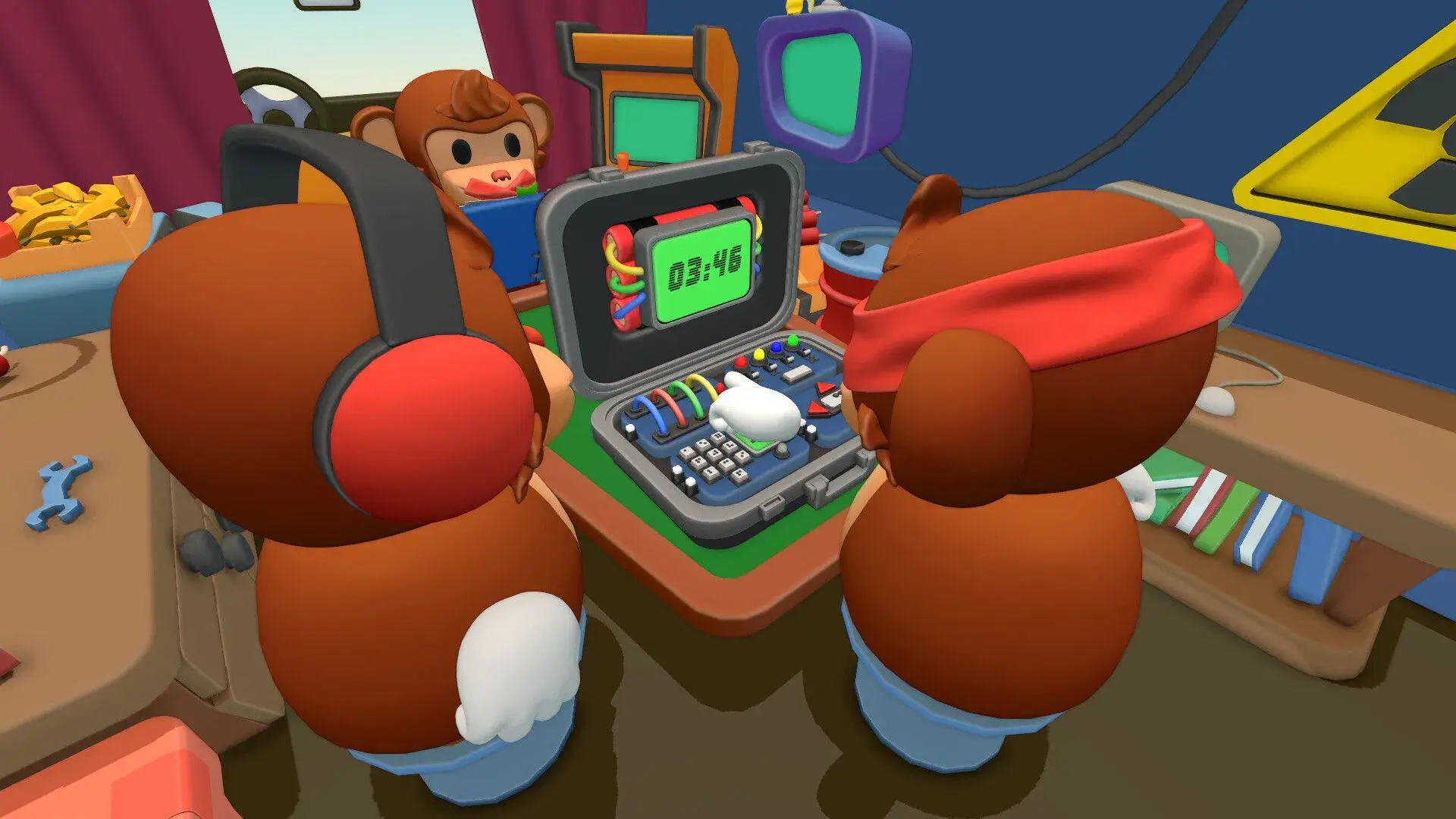
BOMBANANA! is built around a simple idea: three players must defuse a bomb, but each one has a different limitation. One monkey cannot see, another cannot hear, and the third cannot speak. Because of that, even an obvious instruction like cut the red wire can quickly turn into a chain of descriptions, gestures, and confirmations where one misunderstood command ends in an explosion.Image unavailableMost of the difficulty does not come from the puzzles themselves, but from the way the team passes information around. In this guide, we'll explain how the roles work in BOMBANANA!, how to navigate the manual faster, which signals are worth agreeing on in advance, and what to do if someone makes a mistake during a defusal.
How Roles Work in BOMBANANA!
Every match has three players, each with a different responsibility.Blind Monkey cannot see the bomb normally, but can examine it by touch, identify the shapes and positions of modules, and read elements that are available through tactile interaction.Image unavailableDeaf Monkey can see the bomb and the other two players, and can also speak. In practice, this role becomes the link between the other two: you watch the Mute Monkey's gestures and turn them into clear instructions for the Blind Monkey.Image unavailableMute Monkey works with the bomb disposal manual. This player looks up the required rules and solutions, but cannot simply say the answer out loud, so all information has to be communicated through gestures and other available signals.Image unavailableIf even one player starts acting independently, the whole chain quickly falls apart. So before tackling serious levels, the first thing you should agree on is not who is best at solving puzzles, but how exactly you are going to communicate.
Agree on Simple Gestures in Advance
Image unavailableThe most common beginner mistake is trying to invent a sign language while the timer is already counting down. Do not do that.Before the match begins, agree on at least a few basic signals:
yes.
no.
wait.
repeat.
mistake.
up.
down.
left.
right.
wire number.
stage number.
For example, one raised finger can mean the first wire, two fingers the second, and so on. If you also need a separate way to indicate module stages, come up with a different gesture so the same signal is not used for several meanings at once. The important thing is not complexity, but consistency. Even a very basic gesture system works better than improvisation as long as all three players understand it the same way.
Use Nods for Quick Answers
Remember the simplest way to communicate yes or no. The Deaf Monkey can see the other two players, which means they can ask short questions and get an answer with a simple head movement. A vertical nod means yes, while a horizontal shake means no.For example:
Third wire?
Nod.
Red?
Head shake.
That kind of confirmation takes less than a second, while trying to communicate the same answer with a complicated gesture can take much longer. The further you progress, the more often you will use short yes-or-no questions instead of long explanations.
Check Modules in the Same Order Every Time
Another good way to stop wasting time is to decide in advance how the team will go through the bomb's modules. For example, you can move:
clockwise.
top to bottom.
left to right.
column by column.
It does not really matter which option you choose. What matters is that you do not change it halfway through a round. If the team always starts with the top module, then moves to the right and continues clockwise, the Mute Monkey already knows which part of the manual they will probably need next. The Deaf Monkey knows which element to describe, and the Blind Monkey can prepare for the next action. This gives the team a rhythm and prevents the constant question: what are we even solving right now?
Mute Monkey Should Search for the Right Page in Advance
The player with the manual should not passively wait until someone gives a complete description of the module. Start searching as soon as the first clues appear. If you hear someone mention a blue wire, a specific symbol, or a red indicator, immediately move to the most likely section of the manual. Even if your first guess is wrong, you will often still be much closer to the correct solution. Over time, you will start associating certain descriptions with specific pages and diagrams automatically.Image unavailableThat is why it helps to learn the general layout of the manual. You do not need to memorize every rule, but knowing roughly where the wire sections, indicators, sequences, and other module types are located saves a huge amount of time.
Blind Monkey Should Keep Examining the Bomb
The Blind Monkey is not just someone who waits for the final instruction and presses the right button. This role's biggest advantage is touch. Keep examining the bomb, checking the shapes, positions, and states of its elements. Do this not only at the beginning of a module, but also after individual actions, because some elements may change.Image unavailableDescriptions should be short and standardized, for example:
L-shaped module in the top right.
Three dots in a triangle.
Round element with a notch at the bottom.
Descriptions like these are much more useful than long attempts to explain what the thing kind of looks like. The more precisely the Blind Monkey describes the shape and position, the faster the Mute Monkey can find the relevant manual section and the Deaf Monkey can relay the correct instruction.
Deaf Monkey Should Keep Relaying Information
At first glance, the Deaf role may look like the easiest because the player can see what is happening and can speak. In practice, most of the team's communication runs through this player. You have to watch the bomb, the Mute Monkey's gestures, and the Blind Monkey's actions at the same time. The main rule is simple: do not go silent.If the Mute Monkey signals a red wire, say it out loud immediately. If they point to the third element, call it out. If they change their mind and signal a different option, correct the previous instruction right away. At the same time, there is no need to narrate every emotion or random movement. The Blind Monkey hears you and treats your voice as the primary source of information, so unnecessary words only create confusion.Image unavailableUse calm, consistent callouts:
Red wire.
Third from the top.
Wait.
Do not cut.
Cut now.
The less filler between useful commands, the easier it is to act under pressure.
Always Repeat the Command Before Acting
One of the most useful rules in BOMBANANA! is to never press or cut anything immediately after hearing the first instruction.Repeat the instruction before acting, for example:
I'm cutting the blue wire, correct?
Then wait for confirmation and only act after you get it.At first, this extra check may seem like it wastes time, but in practice it saves time. Spending one second on confirmation is much faster than making a mistake, changing the module state, and then trying to figure out what happened. This rule becomes especially important near the end of the timer, when the urge to act faster increases and mistakes become much more common.Speed in BOMBANANA! does not come from pressing buttons faster. It comes from the team no longer making the wrong moves.
After a Mistake, Stop and Start Over
If someone presses the wrong button, cuts the wrong wire, or performs the wrong action, do not immediately try to fix the situation with another command. Stop!A mistake can change the state of the module by activating another indicator, advancing the stage, or changing which rule now applies. That means the information you had before the wrong action may no longer be useful.In this situation, it is better to run through the entire chain again: identify the module and its position, describe its current state, check the manual again, repeat the solution, and only then perform the action after confirmation. Yes, this costs a few seconds. But it is almost always better than continuing the defusal using outdated information and making several more mistakes in a row.
Do Not Change Communication Rules Mid-Round
Suppose you decided that two fingers mean the second wire. Do not suddenly use the same gesture five minutes later to mean the second stage. The same applies to the names you give different elements. If you have been calling a certain symbol a diamond from the beginning, keep calling it a diamond. Do not turn it into a tilted square two rounds later. The team should gradually build its own shared vocabulary.The longer you play with the same group, the shorter your commands can become. Eventually, something that took ten seconds to explain during your first match may be understood from a single word or gesture.
Do Not Use External Voice Chat
Of course, nothing stops you from launching Discord and simply telling each other everything you need to know. Technically, that makes the game much easier, but the restrictions of the three roles are the foundation of BOMBANANA!. If the Mute Monkey starts talking and the Deaf Monkey can suddenly hear everyone else, a large part of the game simply disappears.At least for your first playthrough, it is better to use the game's built-in communication tools and respect the limitations of each role. The funniest and most stressful moments come from being unable to communicate simple information normally.
How to Play as Mute Monkey
Your main job is to work with the manual quickly. Do not try to explain solutions with elaborate pantomime. Use gestures, numbers, and simple signals that the team agreed on in advance. As soon as you hear the first clues about a module, start searching for the relevant section. Do not wait for a complete description.Once you find the solution, communicate it in small pieces. If the answer is the third red wire, first make sure the others understood the number, then the color, and only after that confirm the action. The Mute Monkey is essentially the team's analyst: this player knows the rules, so the entire round depends directly on how quickly they can find the right information.
How to Play as Deaf Monkey
You are the translator between the other two players. Watch the Mute Monkey's gestures, relay them to the Blind Monkey, and keep an eye on the bomb at the same time. Ask as many questions as possible that can be answered with a nod.Do not overload your commands with unnecessary words, and always separate a guess from a confirmed instruction. Phrases like I think it's red... no, wait, maybe blue are almost guaranteed to cause a mistake. If you are not sure, simply say wait and confirm the information first.
How to Play as Blind Monkey
Keep examining the bomb. Do not wait for the others to ask you to check a specific element. The sooner you provide information about the module's shape, position, and other details, the faster the team can find the solution. Before any important action, repeat the instruction you received and wait for confirmation. If you hear several commands at once, do nothing until the team agrees on the final one.Most importantly, do not think of yourself as nothing more than the team's hands. The Blind Monkey is often the first player to discover information the others do not have, so this role needs to take an active part in describing what is happening.
Switch Roles
Even if you have found the perfect player for each monkey, switch roles from time to time. Someone who spent several rounds as the Blind Monkey will have a much better understanding of which descriptions are actually useful when they later play Deaf Monkey. After playing Mute Monkey, it becomes obvious just how frustrating long and imprecise module descriptions can be. And anyone who tries Deaf Monkey quickly learns how difficult it is to watch gestures, the bomb, and spoken instructions at the same time.Over time, this teaches the entire team to communicate information in a way that works for everyone else. You do not need to rotate roles after every bomb. Play several runs with one setup, then switch places.
How to Defuse Bombs Faster
If you combine all of the advice above, the ideal communication flow looks roughly like this:
Blind Monkey examines the bomb and gives a short description of the module.
Deaf Monkey repeats the description and passes it to Mute Monkey.
Mute Monkey is already opening the relevant manual section and signals the solution.
Deaf Monkey turns the gestures into a specific spoken instruction.
Blind Monkey repeats the instruction they received.
The team confirms the action.
Only after that should someone press a button, enter a code, or cut a wire. At first, this system may feel slow, but after a few rounds the sequence starts happening almost automatically. The biggest advantage is that the team stops wasting time fixing random mistakes and endlessly clarifying what someone meant.
What Beginners Need to Remember
Image unavailable
Do not try to solve every problem by moving faster. In BOMBANANA!, organizing the flow of information correctly matters much more.
Before your first serious bomb, agree on gestures and terminology, decide on a consistent order for checking modules, and get used to confirming every important action.
Mute Monkey should search the manual in advance, Deaf Monkey should constantly turn visible gestures into short spoken commands, and Blind Monkey should actively examine the bomb and repeat instructions before acting.
If someone makes a mistake, do not panic and do not try to fix it instantly. Check the current state of the module again before continuing.
During the first few matches, this level of discipline can feel excessive, especially when only a few seconds remain before the explosion. But it quickly becomes obvious that this is exactly what turns three screaming monkeys into a team that can actually defuse bombs.