Home Sweet Home in The Blood of Dawnwalker begins almost casually. Coen makes his way into the alchemist's tower while investigating the appearance of clay gargoyles in Svartrau, finds the records he needs, and climbs higher up the spiral staircase. At the end of the path is a locked door, with the alchemist seemingly waiting somewhere behind it. Everything suggests that another boss fight is about to begin, but the moment Coen steps inside, he suddenly finds himself back in his family home.Image unavailableHis entire family is sitting around the table. His mother is alive, his father is there, and his brothers and sisters behave as if nothing terrible ever happened. Coen realizes almost immediately that none of it is real, but this is where one of the most uncomfortable and powerful quests in The Blood of Dawnwalker begins. The challenge is not really about difficulty. For a while, the game strips Coen of almost everything the player has grown used to, then forces him to relive the trauma he has spent years trying to escape.
The Home That No Longer Exists
The first few minutes of the dream are almost comforting. Coen wakes at the family table, hears his mother's voice, and sees people he lost long ago or became separated from. In another game, this might have been one of those quiet moments where the protagonist is briefly allowed to imagine a normal life. The Blood of Dawnwalker quickly makes it clear that nothing good is waiting here.Monsters attack the settlement, the family scatters, and Coen sets out to save them one by one. This is where it becomes obvious just how much the rules have changed. All of your good armor is gone. Your usual weapons are missing. Accessories and potions disappear, and Coen's vampiric abilities are unavailable as well. Instead of the character you've spent dozens of hours building piece by piece, you're left with an ordinary man carrying a simple sword and very few options.Image unavailableThe enemies have not become weaker to compensate. Spectres surround Coen's mother, attack quickly, and take surprisingly little damage. Outside the dream, a group like this might disappear in seconds. Here, you have to watch every strike, block and parry more often, conserve consumables, and generally play much more carefully.Gradually, it becomes clear that these limitations are not there just to make the section harder. Coen is once again placed in the position of someone desperately trying to save everyone while having almost nothing with which to do it. That feeling is directly tied to what happened to him in the past.
Save Everyone. Again.
Esme is the first person Coen finds. His mother is surrounded by spectres, so you have to fight your way to her with the limited tools the dream has left you. After the battle, you can send her somewhere safe or stay and talk to her in more detail. These optional conversations gradually reveal what is really happening inside Coen.Image unavailableHe misses his mother, but he is angry with her too. After the family tragedy, Esme withdrew into herself and effectively became distant from those closest to her. Coen's feelings toward her remain painful and contradictory. He can blame her, feel sorry for her, or try to avoid returning to the past, but every line makes it clear that, for him, the story never truly ended.There is no time for a long conversation anyway because someone else immediately needs saving. Another group of spectres appears in the village square, including a red-glowing spirit that supports the others and summons more enemies. Without understanding the mechanic, the fight can quickly turn into a drawn-out mess. After that, Coen rescues his brothers and sisters, fights his way to the church, deals with a gargoyle, and eventually reaches his father.At first glance, the job is done. The family is safe, everyone is alive, and it should be time to wake up. Instead, Coen opens his eyes at the same family table, and the entire nightmare starts again.
The Dream Starts Over
This is the moment when Home Sweet Home stops feeling like an unusual side quest and becomes something else entirely. The same relatives are sitting around the table. The same monsters attack the settlement. Coen is once again forced into the role of the person who has to save everyone. The only difference is that the game briefly draws your attention to the well in the village square.There are no direct instructions. It is only a short hint that perhaps you should pay attention to a place you've already passed. If you return to the well after the next fight and interact with it, Coen sees his own reflection. The conversation quickly turns toward the subject he has been avoiding all this time, and for the first time, the name of his younger brother is spoken directly: Alin.His death is the true center of the entire nightmare.
Why Coen Tries to Save Everyone
Throughout The Blood of Dawnwalker, it is easy to notice how strongly Coen reacts whenever someone needs help. He constantly takes on other people's problems, throws himself into dangerous situations, and tries to save people even when doing so seems unreasonable or almost impossible.For a while, this is easy to dismiss as a standard RPG protagonist trait. By the rules of the genre, the main character has to solve dozens of other people's problems. Home Sweet Home gives that behavior a very different explanation.When Coen was a child, he was playing on a frozen lake with his younger brother Alin. An accident happened, and Alin died. Coen was not directly responsible for what happened, but that distinction means almost nothing to him. He was there. He was older. For years, he convinced himself that he should have done something.That guilt eventually became one of the foundations of his personality. If he could not save Alin then, he has to save everyone else now: his mother, his brothers, his sisters, people he knows, and complete strangers. That is why the dream keeps putting Coen in the same situation, with his family in danger and him racing to reach every single one of them.The nightmare becomes an endless attempt to replay the past and prove to himself that this time, things can end differently. That is why the loop does not stop after Coen saves every member of his family and reaches the church. The real problem was never whether he could protect them now. He had to finally accept that Alin could no longer be saved.
The Man in the Well
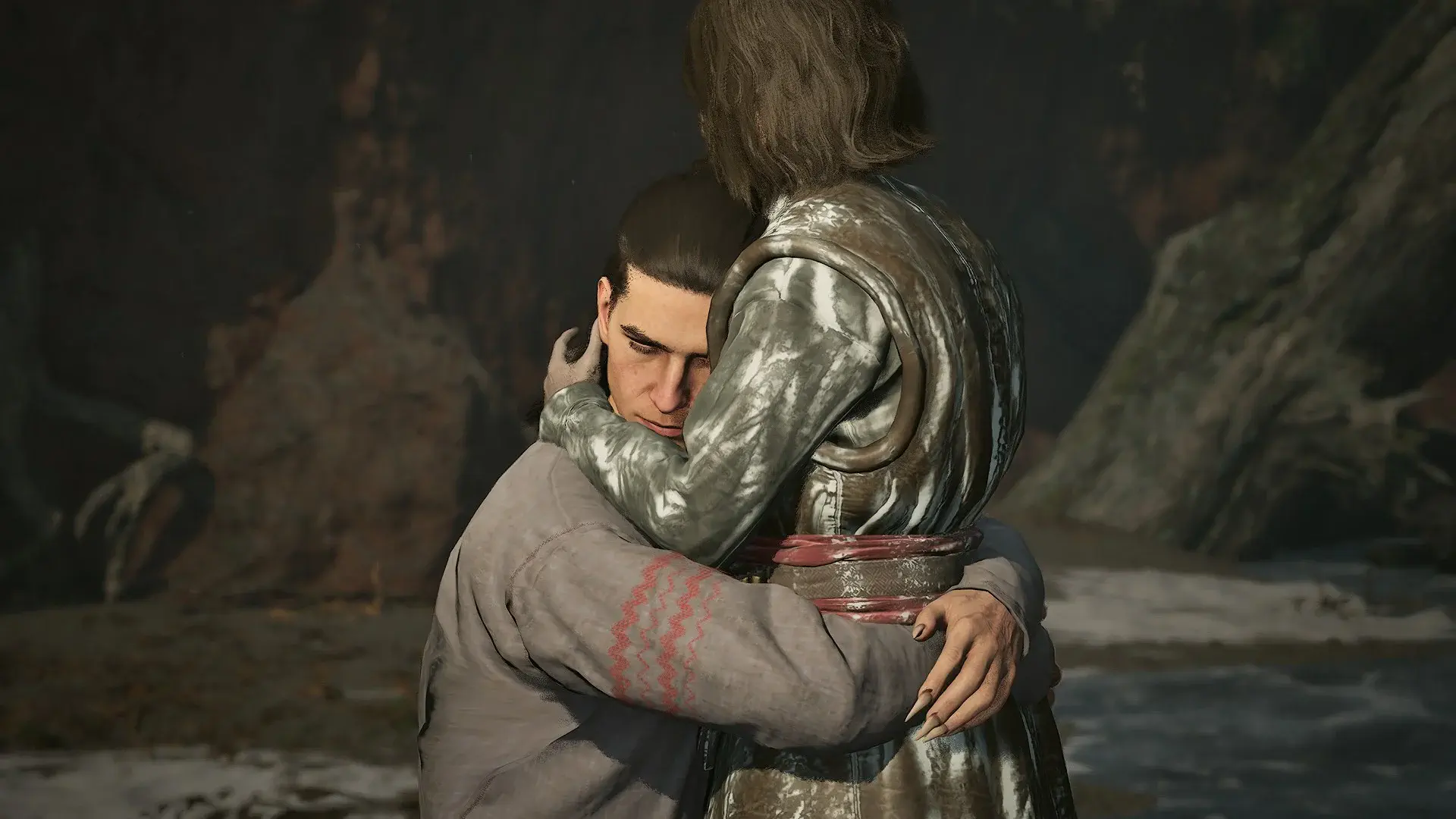
After interacting with the well, the dream gradually begins to fall apart. Coen speaks his younger brother's name, and the familiar nightmare gives way to memories. His vampiric abilities return, and the rest of the sequence becomes less about defeating monsters and more about moving through his own past.Image unavailableAt the end, Coen meets Alin. The scene works precisely because the game does not try to turn what happened into some incredible mystery or shocking twist. It was an ordinary accident in which one child died and another spent years believing he could have prevented it.Alin does not blame his brother. Instead, he tries to make Coen forgive himself and finally stop living inside that tragedy. One of the most painful parts of the scene is the realization that Coen could not bring himself to return to the memory of his brother for all those years, as if he had left Alin alone in the past.Image unavailableAfter the conversation, Alin hugs Coen, and Coen finally lets himself break down. His brother then helps him escape the dream, effectively becoming the one who saves Coen in the end.
Why This Quest Works So Well
As a gameplay section, Home Sweet Home can absolutely be frustrating. The game takes away your proper equipment, forces you to fight with a weak weapon, gives the spectres too much health, and makes you repeat part of a route you've already completed. If you dislike dream sequences, illusions, and looping spaces in games, this can easily become one of the most irritating quests in the entire game.But those exact choices are what make it so effective as a story. The player is placed in roughly the same position as Coen. You are trying to save his family while the game deliberately makes you weaker. You keep trying to move forward while the world keeps sending you back. You look for a familiar gameplay solution to the problem, even though no sword can actually solve it.Before this quest, Coen's need to interfere in every stranger's crisis can be dismissed as a genre convention. The protagonist helps everyone because otherwise half the side quests would not exist. After Home Sweet Home, that behavior reads very differently. Coen is not simply a good person who likes helping people. He is trying to make up for one death for the rest of his life.As a result, his psychological trauma becomes a gameplay mechanic. The repeating level itself, Coen's weakened state, and the need to save the same people again and again all become part of the story instead of simple obstacles between cutscenes. That is why the gameplay and narrative work together here more effectively than in many of the game's much larger sequences.The most unusual part is that Home Sweet Home is a side quest. You reach it through the alchemist storyline and one of the quest threads connected to Xanthe, which means the entire sequence can be missed. If you explore the tower carelessly or resolve the related branch in another way, you may never see one of the most important scenes for understanding the protagonist.It is entirely possible to finish The Blood of Dawnwalker without ever learning how deeply Alin's death shaped Coen. You can miss his mother, never hear the conversation with his brother, and never understand the real reason he tries so painfully hard to save absolutely everyone.That approach is easy to criticize and difficult not to respect at the same time. On the one hand, an incredibly important part of Coen's character is hidden inside an optional quest. On the other, the fact that it arrives unexpectedly is exactly what makes the episode so powerful. You enter a room expecting another boss fight, and some time later, you're watching the protagonist finally stop blaming himself for his younger brother's death after years of carrying it with him.That is why Home Sweet Home is easy to call one of the best quests in The Blood of Dawnwalker. It is also exactly the kind of quest you have absolutely no desire to experience again after finishing it once.