
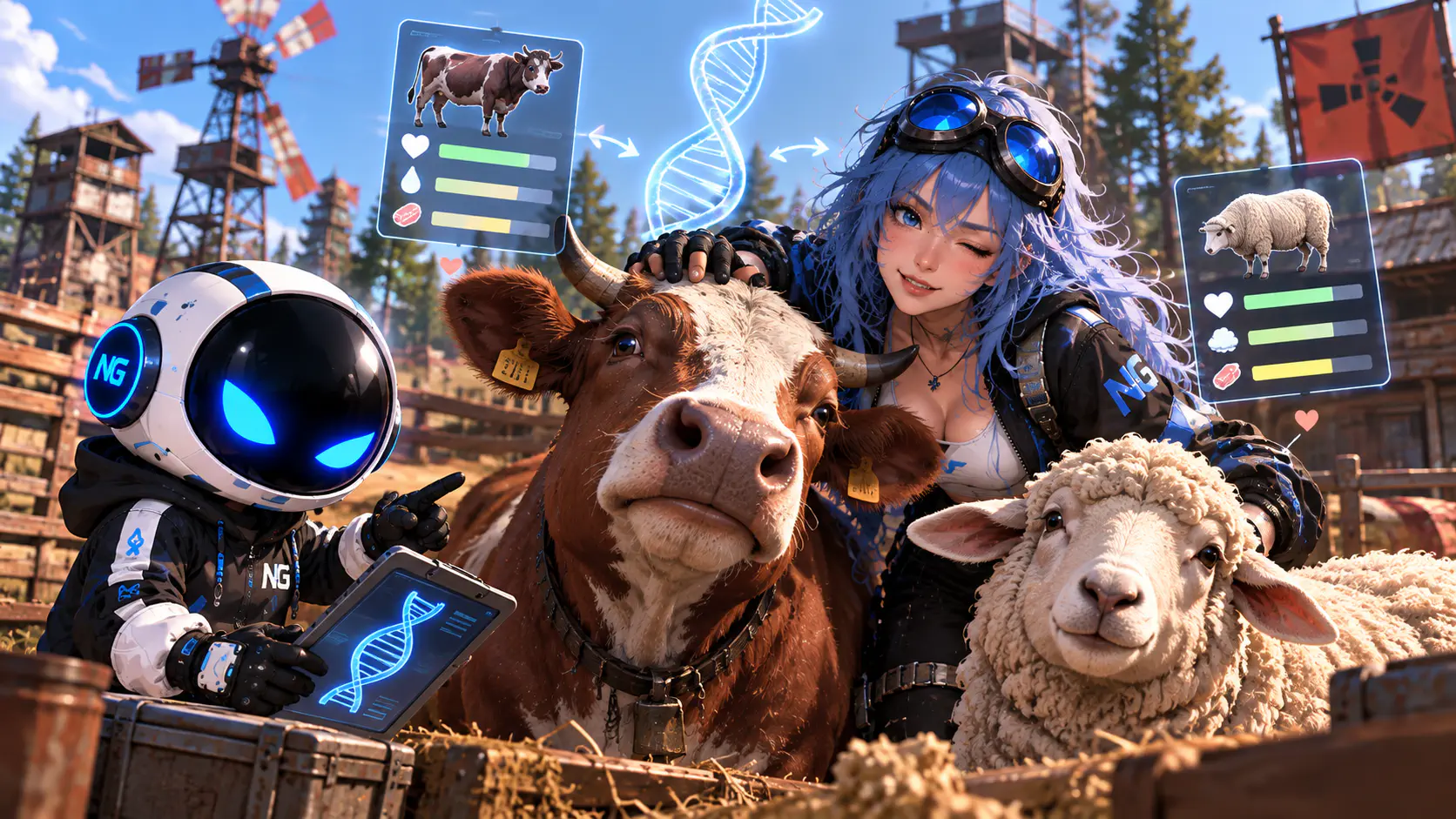

To breed cows and sheep with strong traits in Rust, you need to pair animals with the genes you want, check their offspring, and keep the best candidates for the next generation. There is one important catch: a strong visible trait does not guarantee that a calf or lamb will inherit the same quality. Every trait has two gene copies, while only the stronger copy is expressed. In this guide, we explain how inheritance works, which traits are worth improving first, and why letting every animal in the same pen breed at random is a bad idea.
What you need to breed cows and sheep
The livestock system arrived in the PC version of Rust with the October 1, 2026 update. To get started, you need a tamed adult male and female of the same species: a cow and bull or a ewe and ram. Always check the sex of your animals before bringing them home. If both turn out to be male, even perfect genetics will not solve the problem.You can tame your first animals in the wild or buy young livestock from the Stablehand at the Ranch. A calf costs 300 Scrap and a lamb costs 150 Scrap, and you can choose the sex when buying one. Their genetics are random, so the vendor is useful for getting the missing male or female, but does not sell guaranteed perfect breeding stock. Do not spend all your Scrap immediately. Check the animals you have already brought back to your base first.Prepare a fenced area with a gate and access to food and fresh water. A Hitch & Trough works well for keeping livestock fed, and the pen should have enough room for both adult animals and future offspring. Pasture grass can also help with feeding, but it is gradually consumed. We recommend keeping extra food ready instead of waiting until the whole herd starts looking for lunch outside the usable area.Breeding happens automatically when a tamed adult pair is close enough and their needs are sufficiently met. Under normal conditions, pregnancy lasts around 10 minutes and young animals take about an hour to mature. After giving birth, the female needs time to recover, so not seeing another calf or lamb immediately does not mean the farm is broken. The rate at which animals can reproduce again is also affected by Fertility.What genes do cows and sheep have?
Both species have five traits: Dung, Longevity, Yield, Fertility, and Hardiness. You can view them on the animal's information panel by interacting with it. The English UI uses the letters D, L, Y, F, and H, so these are the terms we use throughout the guide.- D - Dung. Determines how often the animal produces dung. This is useful if you keep livestock mainly to supply fertilizer for a crop farm.
- L - Longevity. Affects how long an adult animal lives. A strong Longevity gene lets you keep valuable breeding stock for longer and replace it less often.
- Y - Yield. Improves milk production in cows and wool production in sheep by affecting the amount produced and how quickly it becomes available again. This is one of the most important traits for a resource-focused farm.
- F - Fertility. Affects reproduction and the amount of offspring. If you want to expand the herd quickly and create more candidates for selective breeding, pay close attention to this gene.
- H - Hardiness. Helps an animal cope with shortages of food, water, and available space. Even a strong Hardiness gene does not remove the need to maintain the pen properly.
How offspring inherit traits
Every cow, bull, ewe, and ram carries two copies of each of the five genes. The offspring randomly inherits one copy from the mother and one from the father. The stronger of the resulting pair is the one that is expressed: Good beats Ok, and Ok beats Bad. This means an animal that visibly has Good Yield can still carry a hidden Bad copy and pass it on to its offspring.For a simple example, imagine one trait as a Good + Bad pair. The animal looks Good for that trait on its card, but it has an equal chance to pass either the Good or Bad copy. If the second parent has the same pair, the possible combinations are:- 25% - Good + Good. The offspring receives two Good copies of the selected gene.
- 50% - Good + Bad. The visible trait is Good, but the weak copy remains hidden and can be passed to the next generation.
- 25% - Bad + Bad. The offspring has a Bad version of that trait even though both parents visibly showed Good.
Can you identify a hidden gene copy?
Sometimes the pedigree lets you make a definite deduction. For example, if one parent has two Bad Yield copies, it can only pass a Bad copy. If its offspring still displays Good Yield, the Good copy must have come from the other parent while the Bad copy remains hidden. That animal can still be useful for production, but it is not genetically pure for that trait.The reverse conclusion requires more caution. Several Good offspring in a row do not prove that the parents have no weaker hidden copies because you may simply have been lucky. We recommend keeping basic breeding records. Even a short note with the parents' names is more useful than trying to remember which of several identical cows was born first.Why inbreeding makes livestock worse
Rust also tracks inbreeding. In addition to the five main traits, animals inherit family markers. Matching inherited markers can trigger an inbreeding penalty that makes the genes work less effectively. Close relatives are more likely to produce this result. That means a brother and sister or a parent and its offspring may look promising on the trait card but still produce a less effective animal.To reduce the risk, we recommend maintaining several separate breeding lines and periodically introducing new animals. Do not use a single original pair as the only source of your entire herd if you plan to breed livestock long-term. Independent origins reduce the risk, but do not eliminate it completely because family markers can still match even between animals with no known close relation.Which livestock traits should you improve first?
For a dairy farm, prioritize Good Yield on both cows and bulls, then work on Longevity and Fertility. Only adult tamed female cows produce milk, but the bull's genetics are still important because future cows inherit half of their gene copies from him. Do not sell a valuable male just because you cannot milk him. His value appears in the next generation.For sheep, the priorities are similar. Yield improves wool production, Fertility helps expand the flock, and Longevity keeps strong animals around for longer. Wool can be collected from both male and female sheep. When shearing, use an appropriate blade and pay attention to which parts have already been cut. Hitting bare skin damages the animal. Good genes will not save your sheep from an overly enthusiastic barber.If your main goal is raising animals quickly for sale, put more emphasis on Fertility and the overall quality of all five traits. The Stablehand values genetics, so specializing exclusively in milk does not always produce the best animal for trading. If you are building a fertilizer farm, Dung becomes the priority instead. Decide what the farm is for before choosing which animals deserve space in the pen.How to breed a better herd step by step
We do not recommend chasing perfect genetics immediately. For the first few generations, choose one main trait such as Yield and keep the best breeding candidates for that trait. Improve the others as useful offspring appear. This makes progress easier to track and prevents the pen from filling with animals that you keep only because each one happens to have a single green icon.- Check your starting herd. Record the sex, important traits, and lineage of each animal. Make a separate note of pairs that have already produced offspring with a weak target trait.
- Choose a pair for your goal. For milk or wool, start with Yield. If the best available partner is a close relative, it is usually better to find a different breeder first.
- Keep living conditions stable. Check food, water, and available space. Leave room for young animals so the first successful birth does not turn the pen into a storage closet.
- Check the offspring and keep pedigree records. Compare specific traits rather than judging the whole card at a glance. A weak result can reveal hidden gene copies in the parents.
- Keep the best animals for the next generation. Do not rush to sell the original breeding stock until you have suitable replacements. Choose the next pairing with lineage in mind again.
What to do if your animals are not breeding
First, make sure both animals are adults, tamed, the same species, and opposite sexes. Then check food, water, crowding, and health. Breeding needs the animals' condition to stay above the required threshold, which is around 60%. If their condition drops too far, reproduction stops. Restore proper conditions and health before waiting for another offspring.If the pair has already bred, check whether the female is pregnant or still recovering. Do not swap breeders after only a few minutes of waiting because a Good gene does not remove the cooldown between births. As the herd grows, we recommend separating animals and removing unnecessary livestock from the breeding pen. Otherwise, it becomes harder to control both living conditions and which pairs are producing offspring.Sign in to leave a comment or rate this post.
Comments
Be the first to comment!